Sunday, Oct. 5 marked the start of banned books week, which was started by the American Library Association in 1982. The Vogel Library will be acknowledging this week in multiple different ways.
The book display by the stairwell will feature both banned books and horror books for October. In addition, Amy Stevenson, the Information Literacy and Community Engagement Librarian, will hold a luncheon on Monday and Tuesday at 12:30 p.m. on the first floor of the Vogel Library talking about book bans and what they are.
Stevenson says that it is important for Vogel Library to bring awareness to Banned Books Week so college students can understand that having access to resources is critical for a community.
“We don’t want someone else deciding for you what is right or wrong,” Stevenson says, “We want you to have access to it so that you can decide if it’s right or wrong for you.”
Stevenson says that it is very rare for books to be banned outright. However, bans or removals can and do happen in smaller areas, such as schools and districts, as the challenge is brought up by concerned community members. She says that to advocate for banned books, it is important to be aware of what is going on in your community and to make sure that those who are challenging the book have read it.
Stevenson also gave suggestions for individuals who might feel uncomfortable with a book on public shelves. The first step is asking yourself what makes you uncomfortable with the material, that if discomfort is caused by a lack of knowledge on the subject, you could research or ask someone who is knowledgeable for help. She also says that some topics are just that: uncomfortable, this is because the authors intended it to be that way.
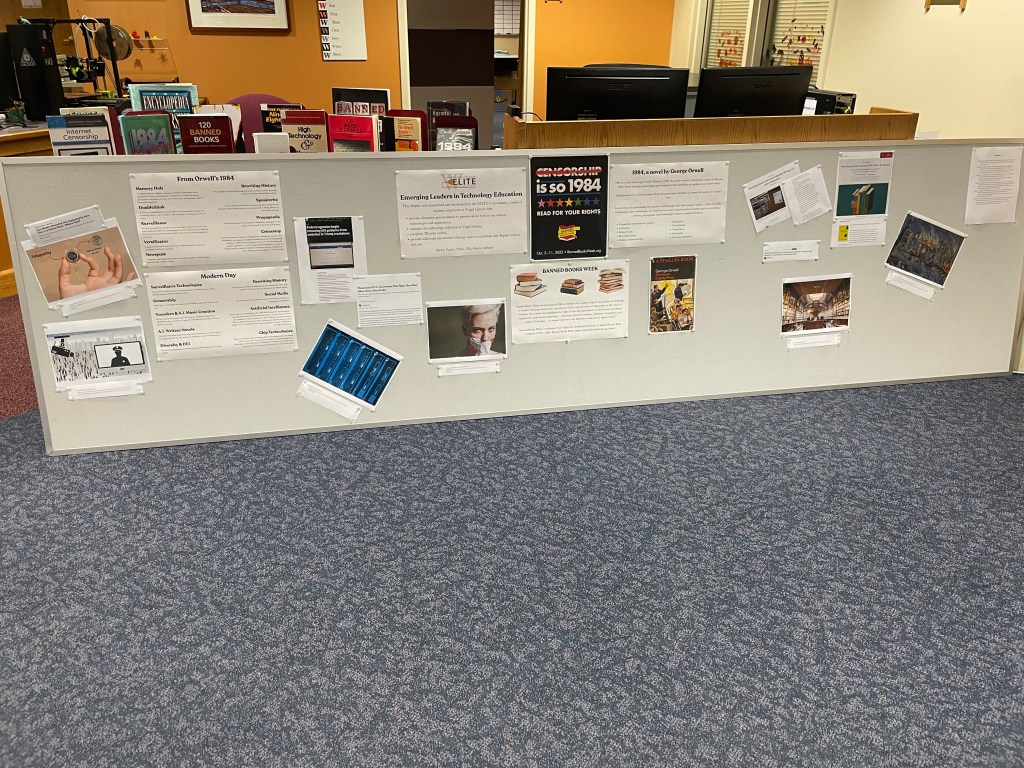
At the ELITE desk, which is the technology desk at Vogel Library, employees will be discussing imaginary technology mentioned in George Orwell’s 1984 and what items we have today that are similar.
According to the American Library Association, this year saw the third highest number, 821, of material challenges since 1990. Challenges means an attempt to be banned. Organized movements attempted 72% of these challenges, and 76% of challenges are books. Other materials that are challenged include films, programs and displays. 55% of these challenges occur at public libraries.
The top ten most challenged books this year on the American Library Association’s list are: “All Boys Aren’t Blue” by George M. Johnson, “Gender Queer: A Memoir” by Maia Kobabe, “The Bluest Eye” by Toni Morrison, “The Perks of Being a Wallflower” by Stephan Chbosky, “Tricks” by Ellen Hopkins, “Looking for Alaska” by John Green, “Me and Earl and the Dying Girl” by Jesse Andrews, “Crank” by Hopkins, “Sold” by Patricia McCormick and “Flamer” by Mike Curato.
In Iowa, there have been many challenges to books, as the Des Moines Register explains, Senate File 496 states that grades K-6 cannot have “any program, curriculum, test, survey, questionnaire, promotion, or instruction relating to gender identity or sexual orientation” and removes books that have any sex description or visual from K-12, except for the Bible. In the past year, there were 17 attempts in Iowa to ban books, with 261 titles included.
The top ten books in Iowa that have been restricted after Senate File 496 are: “Nineteen Minutes” by Jodi Picoult, “Looking for Alaska” by John Green, “Sold” by Patricia McCormick, “Thirteen Reasons Why” by Jay Asher, “The Perks of Being a Wallflower” by Chbosky, “The Kite Runner” by Khaled Hosseini, “Crank” by Hopkins, “Identical” by Hopkins, “The Handmaid’s Tale” by Margaret Atwood and “The Color Purple” by Alice Walker.
Two years ago, there was a book removal in Waverly Shell-Rock High School. The book, “Persepolis” by Marjane Satrapi, was used as a required text in tenth grade classrooms until it was challenged and removed after parents raised concerns about content they thought was inappropriate.
Most of the books on this list are at the Vogel Library with the exceptions of the books by Ellen Hopkins, “Thirteen Reasons Why” and “Me and Earl and the Dying Girl.” However, “Me and Earl and the Dying Girl” is available on film in the Vogel Library.
The Vogel Library also has “The Color Purple,” “The Kite Runner” and “The Perks of Being a Wallflower” on film. “Persepolis” is also available in the Vogel Library in English and Japanese. To view these resources, click here.
If you would like to learn more about other banned books or the history of banned books, check out the American Library Association’s website.